
You buy a curl cream because the reviews swear it gives glossy ringlets. It leaves your hair flat. Then you try a gel that promises definition. Your curls feel crunchy, your roots look greasy, and by day two everything turns into frizz.
A few months later, the bathroom shelf is crowded with half-used bottles. Some were too heavy. Some were too drying. Some seemed fine, but only on wash day and never again. If that sounds familiar, you are not bad at doing your hair. You are probably using products that do not match your hair’s structure.
That mismatch is common because most curly hair advice remains too broad. “Use more moisture” helps some people and sabotages others. “Avoid sulfates” works for some routines and creates buildup for other heads of hair. “Try this viral styler” says nothing about whether your strands are fine, dense, low porosity, or protein sensitive.
The best products for curly hair are not the most expensive ones or the most hyped ones. They are the formulas that fit your curl profile, your scalp needs, and the way your hair responds to moisture, protein, oils, and hold.
This guide takes a different route. Instead of handing you a random shopping list, it shows you how to read your own hair first. Once you know what your hair is asking for, product labels stop feeling mysterious. You start spotting why one mousse lifts your waves while another turns them limp. You understand why one leave-in gives softness while another sits on top like lotion on plastic.
That is how you get out of the trial-and-error cycle. Not by buying more, but by buying smarter.
Your Journey to Healthier Curls Starts Here
A lot of curly routines fail for a simple reason. The product sounds right, but the formula solves a different problem than the one your hair has.
Take two people with “frizzy curls.” One has dry, high-porosity hair that loses moisture fast and needs richer conditioning. The other has low-porosity hair with product buildup, so anything creamy just piles up and dulls the curl pattern. They both describe the same symptom. They need different products.
That is why generic lists of the best products for curly hair can be so frustrating. A product can be excellent and yet be wrong for you.
Why your curls may seem unpredictable
Curly hair is shaped by bends and twists along the strand. Those bends make it harder for natural scalp oils to travel from root to end. The result is familiar. Dryness, tangles, rough ends, and frizz frequently appear even when you are trying hard to moisturize.
But “more moisture” is not always the whole answer. Hair also reacts to:
- How easily it absorbs water
- How long it holds onto moisture
- Whether it likes protein or gets stiff from it
- How heavy or light each formula feels
- How much buildup sits on the strand and scalp
A cream that makes one person’s curls springy can make another person’s hair look stretched and oily.
Stop chasing miracle products
The helpful shift is this. Start treating products like tools, not magic.
A leave-in has a job. A gel has a job. A clarifying shampoo has a job. A protein styler has a job. Once you understand the job, you can decide whether your hair needs that tool right now.
Tip: If a product disappointed you, it does not always mean it was bad. It may have been the wrong tool for your current hair condition.
That mindset also saves money. Instead of collecting ten stylers that all do roughly the same thing, you build a small routine with purpose.
A better way to choose
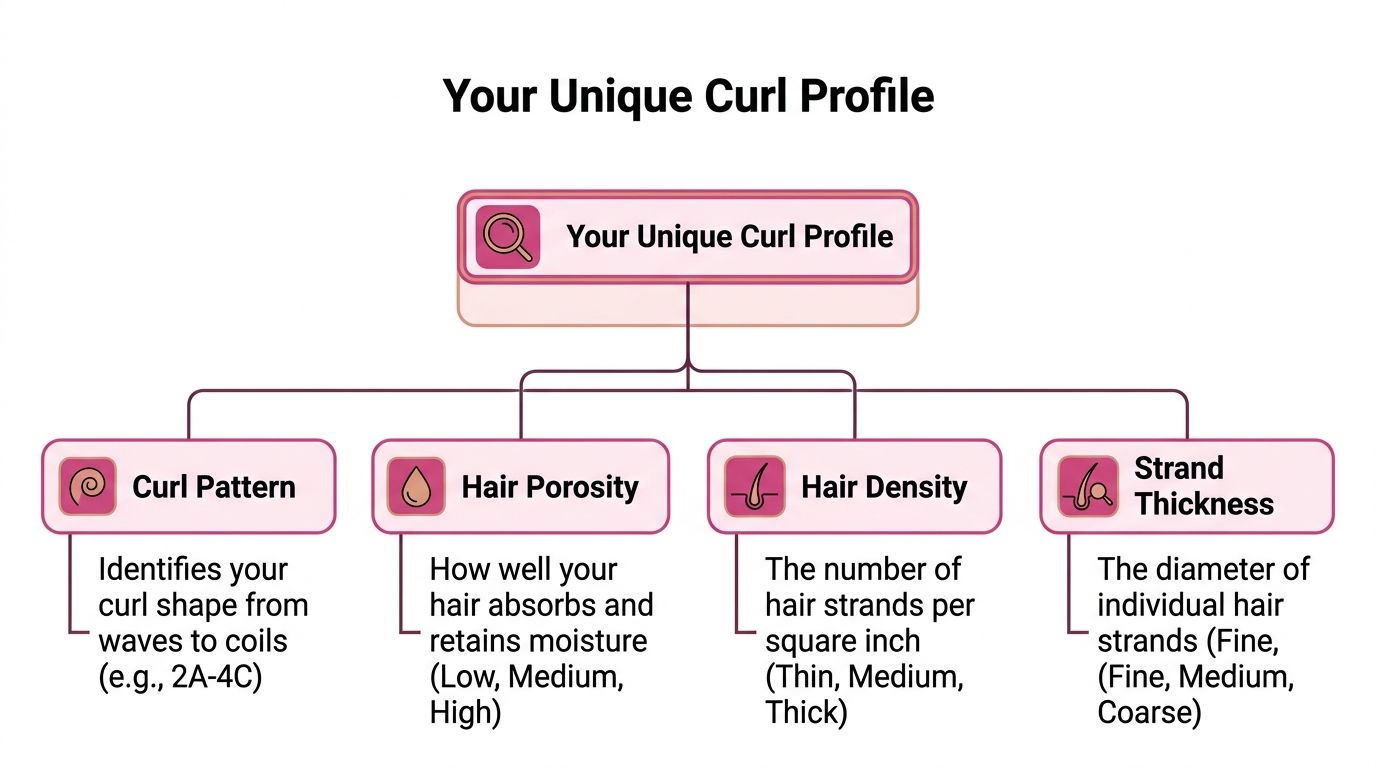
When I help someone simplify their curl routine, I begin with four questions:
- What does your curl pattern look like?
- How porous is your hair?
- Are your strands fine, medium, or coarse?
- Do you need moisture, strength, scalp care, or lighter styling?
Those four answers tell you much more than any “best seller” badge.
By the end of this guide, you should be able to look at a bottle and think clearly: this is likely too rich for me, this protein level might help, this cleanser may remove buildup without stripping, or this mousse fits my fine waves better than a dense cream.
That is the skill that matters. Trends change. Your understanding stays useful.
First Understand Your Unique Curl Profile
The fastest way to waste money on curly products is to shop before you know your hair profile. Individuals often start with curl pattern because it is visible. That helps, but it is only one part of the picture.
Curl pattern tells you shape
Curl pattern describes the shape your hair naturally forms.
- Type 2 waves form loose S patterns
- Type 3 curls form spirals or ringlets
- Type 4 coils form very tight curls or zig-zag patterns
A simple way to think about it is size. Loose waves look broad and open. Tighter curls wrap around themselves more closely. Some people compare tighter ringlets to the width of a pencil or smaller objects. You do not need to label yourself perfectly. Most heads of hair contain more than one pattern anyway.
What matters is what the shape suggests about styling needs.
Wavy hair frequently gets weighed down easily. It often prefers lighter leave-ins, mousses, and softer creams. Tight curls and coils frequently need more slip, more conditioning, and stronger moisture support to stay flexible and defined.
Porosity tells you behavior
Porosity matters even more than curl pattern when you are choosing formulas. It tells you how easily your hair takes in moisture and how well it keeps it.
Think of porosity like a sponge.
- Low-porosity hair is like a tight sponge. Water tends to bead up or sit on the surface before soaking in.
- High-porosity hair is like a more open sponge. Water gets in quickly, but it can escape quickly too.
- Medium-porosity hair absorbs and holds moisture in a more balanced way.
Two people can both have 3A curls and need very different products because one is low porosity and the other is high porosity.
A simple at-home porosity clue
You do not need a lab test to get useful clues. Try a basic spray bottle test on clean, product-free hair.
Mist one section lightly with water.
- If the water seems to sit on top for a while, your hair may lean low porosity
- If it absorbs fairly easily and feels balanced, you may be medium porosity
- If it drinks up water fast but also dries out quickly, your hair may be high porosity
This is not a perfect diagnosis, but it is practical and enough to improve your product choices.
Key takeaway: Curl pattern tells you what your hair looks like. Porosity tells you how it behaves. Product choice depends heavily on behavior.
Density and strand thickness change everything
People confuse density with strand size.
- Density means how much hair you have on your head
- Strand thickness means how thick each individual strand is
You can have fine strands and a lot of them. You can have coarse strands and lower density.
Fine hair gets overloaded easily, even if it is curly. Coarse hair, by contrast, tolerates richer formulas better. Dense hair may need sectioning and more product distribution, while low-density hair can look greasy from the same amount.
Why one-size-fits-all curl rules fail
Curly hair advice frequently becomes hard rules. One of the biggest examples is shampoo.
Mainstream curl guidance frequently states everyone with curls should avoid sulfates. But that does not work for every head of hair. A review discussing low-porosity curl care notes that exclusive sulfate-free routines can leave residue on some low-porosity hair, reducing definition, and that a mild clarifying shampoo used bi-weekly may work better for resilient curls or buildup-prone scalps in some routines (review reference).
That does not mean harsh cleansing is always better. It means your hair profile decides.
A quick profile sketch
If you are not sure where you fit, start with a rough description like this:
| Factor | What to notice | Product clue |
|---|---|---|
| Pattern | Loose waves, ringlets, or tight coils | Lighter vs richer stylers |
| Porosity | Water sits on top or soaks in fast | Buildup-prone vs moisture-loss prone |
| Density | Scalp shows easily or hair feels very full | Amount of product needed |
| Strand size | Fine, medium, or coarse | Whether formulas will feel heavy |
You do not need perfect labels. You need enough clarity to stop buying products meant for someone else’s hair.
Decoding Ingredients What to Seek and Avoid
Once you know your hair profile, ingredient lists become easier to read. You are no longer staring at a wall of chemistry. You are looking for function.

Moisture ingredients and what they do
Curly hair needs ingredients that attract moisture, soften the strand, or help seal it in.
Humectants draw water toward the hair. Glycerin is one of the most familiar examples. In curly routines, humectants can help hair feel softer and more hydrated, especially in leave-ins and creams.
Emollients smooth the hair surface. Think shea butter and many plant oils. These can reduce roughness and help the strand feel more flexible.
Film-formers and soft conditioners help with slip, detangling, and frizz control. These are what make a leave-in feel immediately helpful.
The trick is matching weight to your hair.
- Fine or low-porosity hair prefers lighter hydration
- Dry, coarse, or high-porosity hair needs richer support
- Wavy hair needs less butter and fewer heavy oils than coily hair
If a product has a long list of rich oils and butters near the top, it may be wonderful for someone with thirsty curls and too much for someone whose hair collapses easily.
Protein is useful, but not always gentle
Protein is one of the most misunderstood parts of curly care. It is not good or bad.
Curly hair benefits from protein because it can help reinforce weak areas along the strand and improve definition. Curl-focused guidance notes that products with protein can enhance and tighten curl patterns, but overuse on protein-sensitive hair can lead to brittleness and breakage. The same guidance recommends applying stylers to soaking-wet hair for more even distribution and less frizz (Curl Maven on protein and application).
That means protein works best when it matches your hair’s needs.
Signs you may appreciate some protein:
- Hair feels overly soft, limp, or mushy when wet
- Curls lose shape quickly
- Strands seem weak after coloring or heat exposure
Signs you may need less protein:
- Hair feels hard, straw-like, or stiff
- Ends snap easily
- Your curls lose softness and bounce after repeated protein use
Cleansing ingredients matter more than labels
“Clean,” “curl-safe,” and “sulfate-free” are not enough information on their own. You still need to ask what the cleanser does on your scalp and hair.
Some people do well with very mild cleansers and co-washes. Others, especially people with buildup, oils, or low porosity, need a more thorough reset from time to time.
A useful way to think about cleansers:
| Cleanser type | Best for | Watch out for |
|---|---|---|
| Co-wash | Very dry hair, light refresh cleansing | Can leave residue on buildup-prone hair |
| Low-poo | Regular cleansing with less stripping | May still feel too mild for some scalps |
| Clarifying shampoo | Removing residue, oil, and stubborn buildup | Can feel drying if overused |
Some curl routines improve dramatically when the person stops fearing all stronger cleansing and starts using it strategically.
Silicones and drying alcohols need nuance
You do not need a blanket ban list. You need context.
Silicones can create slip and shine, but some formulas can also leave a coating that weighs down waves or makes moisture layering harder. Hydration-focused curl guidance emphasizes silicone-free formulas for preserving wave movement because heavy coatings can flatten the pattern and interfere with bounce, especially in lighter textures (Harklinikken on silicone-free hydration).
That does not mean every silicone will ruin every curl. It means if your hair feels coated, limp, or hard to rehydrate, silicones are worth investigating.
Drying alcohols deserve the same balanced view. In some products they help with quick drying or hold. In excess, especially on already dry hair, they can leave the strand feeling rough.
How to predict a product before you buy it
Try this quick scan when reading a label:
- If water is first and the formula includes lighter hydrators, it may suit fine hair or low-porosity hair better.
- If rich butters and oils appear early, expect more weight and more sealing.
- If protein shows up high in the list, be cautious if your hair gets stiff easily.
- If the product promises hold, look for whether it is a mousse, cream, or gel so you know how much structure to expect.
- If your goal is scalp support, a serum may make more sense than another styling cream.
For readers comparing treatment textures, this serum image example is a useful reminder that product format matters as much as ingredient buzzwords. A serum is built for a different job than a custard or leave-in.
Tip: Do not ask whether an ingredient is “good.” Ask what job it does, how much of it is likely in the formula, and whether your hair needs that job.
That question is what turns ingredient reading into a practical skill.
Building Your Core Product Toolkit
Many find success with a small toolkit that covers cleansing, conditioning, moisture support, and definition.
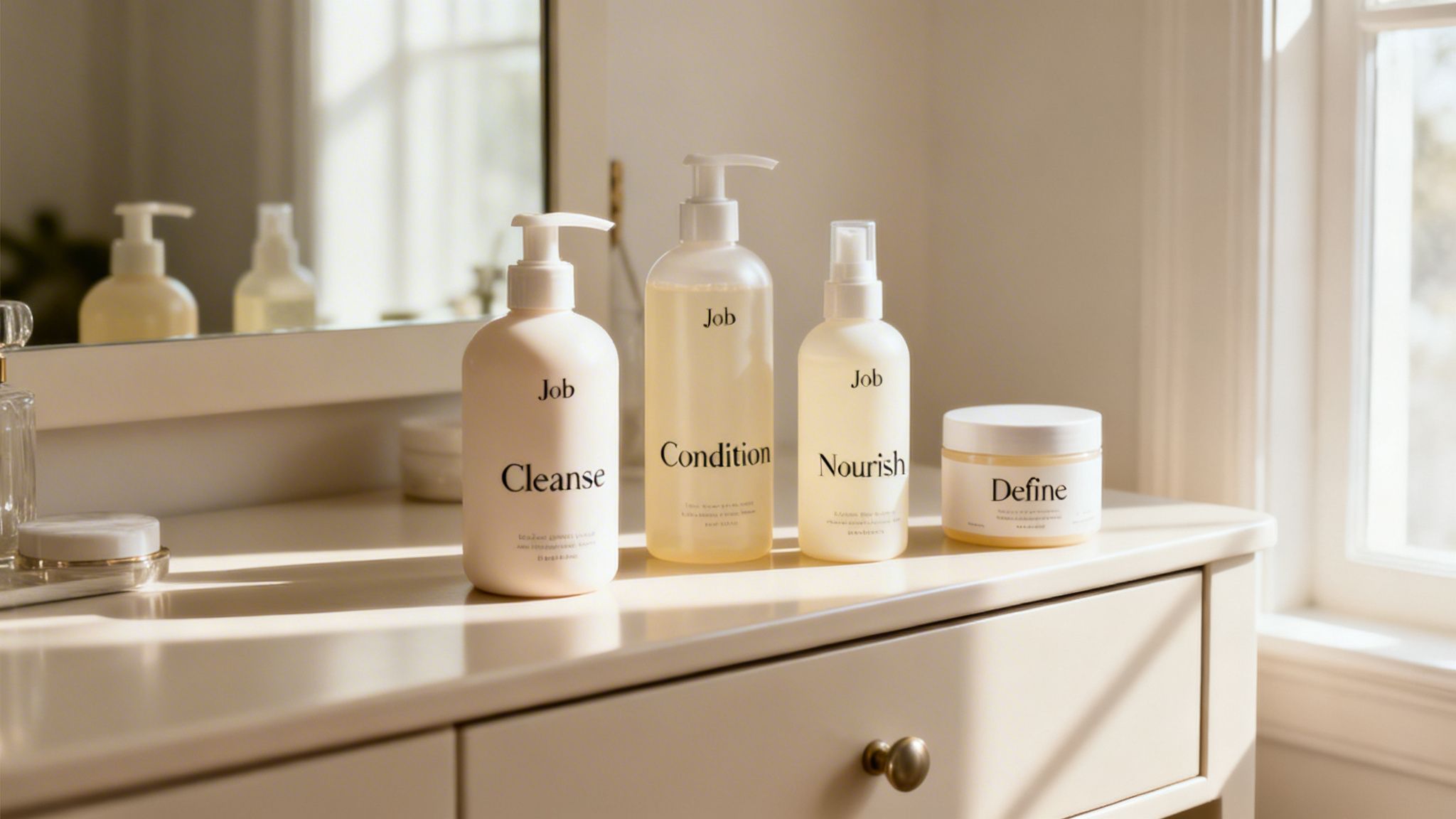
Consider it a capsule wardrobe for your hair. A few pieces do most of the work. The key is choosing the right version of each piece.
Cleanser choices
Your cleanser sets the tone for everything else. If it leaves too much residue behind, your stylers struggle. If it strips too hard, your hair gets rough and puffy.
A balanced toolkit includes one of these as your regular option:
- Low-poo shampoo for consistent cleansing without a harsh feel
- Co-wash if your hair is very dry and your scalp tolerates it well
- Mild clarifying shampoo for occasional reset when hair feels coated, limp, or hard to style
People with low-porosity or buildup-prone curls benefit from keeping a clarifier nearby, even if they mostly use gentler cleansing the rest of the time.
If you like minimalist formats, some readers also explore concentrated options such as shampoo and conditioner bars, though the same rule applies: the formula matters more than the format.
Conditioners and masks
Rinse-out conditioner gives slip and softness after cleansing. It helps detangle and prepares the hair for styling.
Deep conditioners and masks go further. They are useful when hair feels extra rough, overworked, or depleted. The important question is not “Do I need a mask?” but “What kind?”
If your hair is dry but strong, a moisture-focused mask may help. If it is weak and floppy, a treatment with some protein may make more sense. If you use a heavy mask every wash day on fine or low-porosity hair, you may end up with softness but no lift.
Leave-in is often the quiet hero
A lot of people obsess over gels and creams and underestimate leave-in conditioner. That is a mistake.
A YouGov survey found that 28% of US women with curly or wavy hair regularly use leave-in conditioners, making it the top styling choice in that group (YouGov curly and wavy hair product usage). That makes sense. Leave-ins handle multiple jobs at once: moisture support, detangling, smoother cuticle feel, and a better base for stylers.
If your routine feels messy, a good leave-in helps bring order to it. It can make your gel perform better, reduce friction during styling, and help curls stay softer between washes.
Stylers each solve a different problem
Do not lump all stylers together. They create different results.
Mousse and foam
Best when you want lift, light definition, and less weight. Fine waves and fine curls frequently respond well here.
Mousse can add body without the coated feeling that dense creams sometimes create. It is a smart starting point for anyone who says, “Every curly product is too heavy for me.”
Curl cream
Best when your hair needs softness, moisture, and some shaping. Creams are ideal for drier curl patterns, but they vary wildly in richness.
A lightweight cream can work beautifully on softer curls. A butter-heavy cream may be too much for fine strands.
Gel and custard
Best for hold, frizz control, and longer-lasting definition. If your curls look good when wet but expand into fluff as they dry, you may need more hold rather than more oil.
Many people get better results from using less cream and more gel, especially in humid conditions.
This video is useful if you want to see product categories in action and compare how styling choices change the final result.
A simple toolkit by hair feel
Here is a practical way to build your set:
| If your hair feels like this | Start with this toolkit |
|---|---|
| Dry and frizzy | Gentle cleanser, richer conditioner, leave-in, gel or cream-gel |
| Fine and limp | Light cleanser, lightweight conditioner, small amount of leave-in, mousse |
| Coated and dull | Mild clarifier, balanced conditioner, lighter leave-in, stronger hold styler |
| Weak and undefined | Balanced cleanser, conditioner, measured protein support, gel or custard |
Key takeaway: Your toolkit should cover jobs, not trends. Cleanse, condition, leave in moisture, then choose a styler based on the finish you want.
That is sufficient for many to start seeing patterns in what their hair likes.
Tailoring Products to Your Hair Concerns
Sometimes the curl pattern is not the primary issue. The bigger issue is dryness that never ends, an itchy scalp, thinning around the edges, or fine strands that collapse under every “curly hair” recommendation. Patient testing helps in this situation.
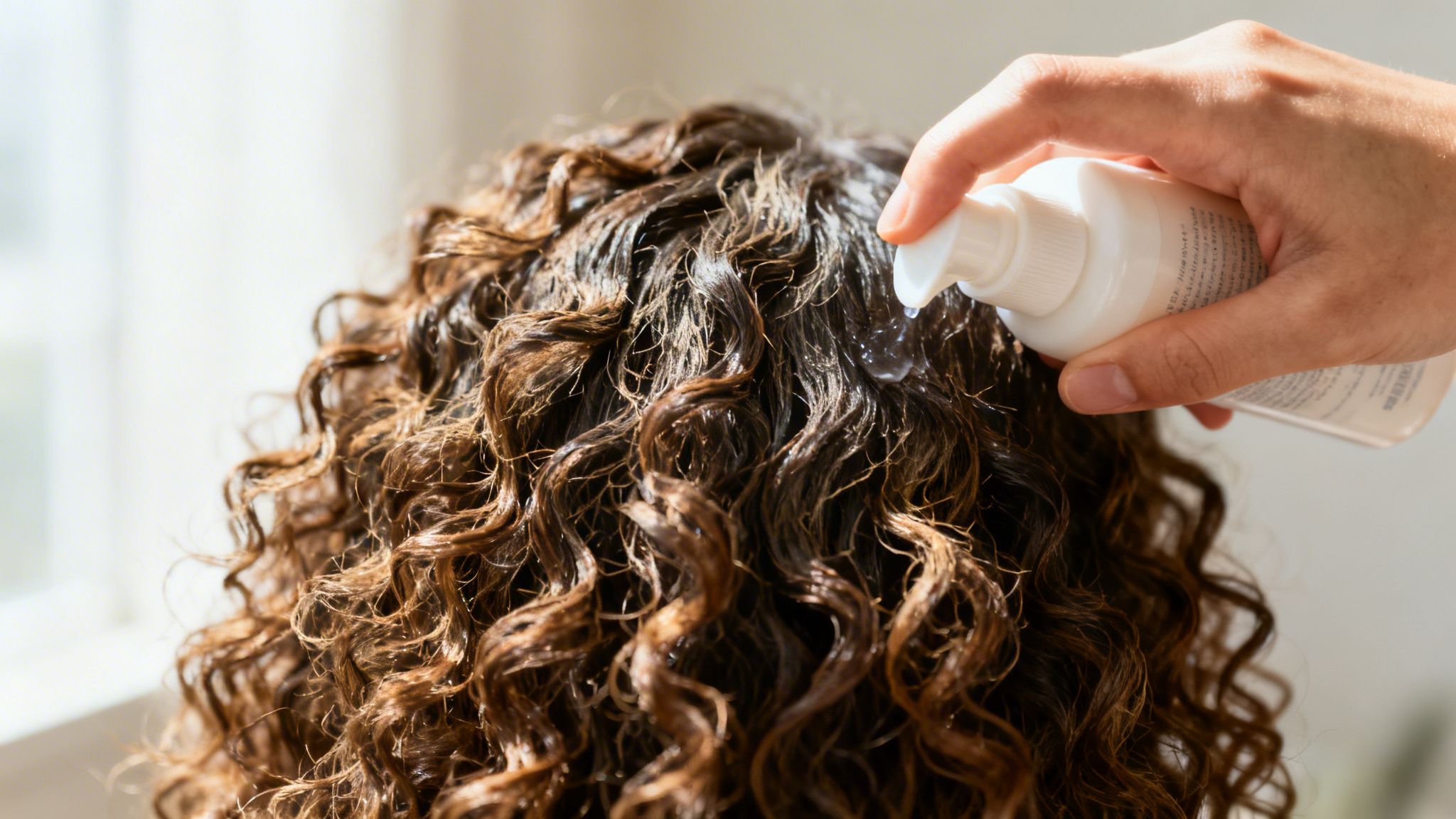
If your curls are consistently dry
Constant dryness means one of two things. Your hair is not getting enough water-based hydration, or it is not holding onto that moisture well.
Start by looking for leave-ins and conditioners that focus on hydration instead of just shine. Products that feel slippery and water-based help more than heavy oils alone. Oils can seal, but they do not replace moisture by themselves.
If your hair is coarse or high porosity, richer creams and sealing ingredients may help after you hydrate. If your hair is low porosity, too much butter can sit on the surface and make dryness feel worse because the hair never absorbs what is on it.
If your scalp gets itchy or flaky
A lot of curl routines focus only on the hair shaft and ignore the scalp. That backfires quickly.
If your scalp feels congested, coated, or flaky, review your cleansing routine first. Heavy oils layered repeatedly can be part of the problem for some people. So can co-washing too often if your scalp needs a cleaner reset.
Look for a routine that keeps styling buildup under control. Many with curls benefit from alternating a gentler shampoo with a more clarifying wash as needed. Your scalp comfort improves before your curl definition does.
If you prefer natural-feeling care
For those who prefer natural-feeling care, ingredient function matters more than marketing language. “Natural” can be too heavy, too oily, or too fragranced for your scalp.
If you prefer simpler-feeling products, start with lightweight leave-ins, aloe-based hydrators, or oils used in small amounts rather than as the center of the routine. Product feel matters. A formula can contain lovely plant ingredients and overload your hair.
A good example is how some people use an olive oil treatment format occasionally for softness, while relying on lighter daily products for actual styling control.
If your hair is thinning or growing slowly
Scalp-focused serums and oils are more useful here than adding another styler. The goal is not just to make hair look smoother for one day. The goal is to support the scalp environment.
Usage patterns show this category matters to curl consumers. In US surveys, 21% of curly or wavy-haired women use serums regularly, and these products are commonly chosen for concerns such as scalp circulation, frizz, shine, and stronger-looking growth support, especially when formulated with ingredients like biotin, castor oil, peppermint oil, and vitamin E (curly hair serum usage and ingredients).
That does not mean every serum will transform your hairline. It means serums are a sensible category to explore when your concern is scalp support rather than surface styling.
Tip: If your main concern is thinning, separate your routine into two lanes. One lane for scalp care. One lane for styling. A curl cream cannot do the job of a scalp serum.
If your curls are fine and easily flattened
This is one of the most overlooked groups in curl care. Fine wavy and curly hair gets advised to use richer creams, heavier oils, and lots of layering. Then the person wonders why their roots collapse and their definition disappears.
Fine hair needs a lighter hand and lighter textures. Mousses, foams, and light gels outperform rich custards here. A small amount of leave-in may be enough. In some routines, skipping cream entirely improves the final result.
If your hair feels wiry, rough, or aging
Hair that has become rougher with time requires both softness and support. Too much softness can make it limp. Too much protein can make it feel rigid.
In this situation, patient testing helps. Try one change at a time. Add a more nourishing conditioner, or a product with some protein, but do not change six things at once. When hair texture has shifted, a balanced routine works better than an extreme one.
A concern-based approach keeps you from buying products for the wrong problem. Dryness needs one strategy. Buildup needs another. Thinning needs another. Fine texture needs another. Once you match the concern to the product category, shopping gets far less confusing.
Your Smart Shopping Checklist and Starter Routine
By this point, the best products for curly hair should feel less mysterious. You do not need a perfect routine from day one. You need a method for making better choices.
Your shopping checklist
Take these questions with you before you buy anything.
- What is my porosity? If your hair resists moisture and gets buildup easily, avoid assuming richer is better.
- Are my strands fine, medium, or coarse? Fine strands need lighter formulas and smaller amounts.
- What job do I need this product to do? Cleanse, detangle, add moisture, support the scalp, or create hold.
- Does the formula look rich or light? Scan for butters, heavy oils, protein, and whether the product is a mousse, cream, gel, or serum.
- Am I solving a real problem or reacting to hype? Buy for your current hair behavior, not someone else’s result.
- Will this work with what I already own? A great gel can still fail if it is layered over a leave-in that is too heavy.
- Does my scalp need attention too? Curl definition improves when scalp buildup is addressed.
- Could I start with one product instead of three? This is especially useful if you are testing protein or trying a new hold product.
A simple starter routine for low-porosity hair
Low-porosity curls perform best when the routine stays clean, light, and intentional.
- Cleanse with a gentle shampoo, not endless layering over old product.
- Condition with a lighter rinse-out, focusing on slip rather than heavy coating.
- Use a small amount of leave-in only if your hair benefits from it.
- Style with mousse or a light gel for lift and definition.
- Clarify regularly if buildup shows up, especially if your curls start looking dull or stretched.
This routine helps hair feel fresher and more responsive.
A simple starter routine for high-porosity hair
High-porosity curls need help keeping moisture in and preserving definition.
- Cleanse without over-stripping
- Use a more nourishing conditioner
- Apply leave-in while hair is very wet
- Seal with a cream, gel, or cream-gel depending on how much hold you need
- Use occasional strengthening support if curls feel weak
This approach helps reduce the cycle where hair feels soft when wet and dry again once it is fully air-dried.
A note for fine wavy and curly hair
This group is under-served in most curly content. Guidance focused on thick curls can lead fine textures straight into overload. That gap matters because data discussed by Curl Maven notes that 30% of curly-related search queries specify “fine” or “wavy,” while less than 10% of top articles address those needs, and lightweight mousses are often a better match for definition without excess weight (fine wavy and curly hair product gap).
If you have fine hair, do not treat heaviness as the price of hydration. There are lighter ways to get definition.
The skill that changes everything
The true upgrade is not a single miracle bottle. It is your ability to diagnose.
You notice buildup faster. You recognize when your hair needs hold instead of oil. You stop assuming frizz always means dryness. You understand that “best” always depends on context.
That is what makes curl care feel calmer. Your routine gets smaller. Your purchases get smarter. Your hair starts making more sense.
If you want more practical beauty guidance without the hype, visit Hair and Body review. It is a helpful place to find honest product insights, compare options, and build a routine that fits your hair and skin needs.