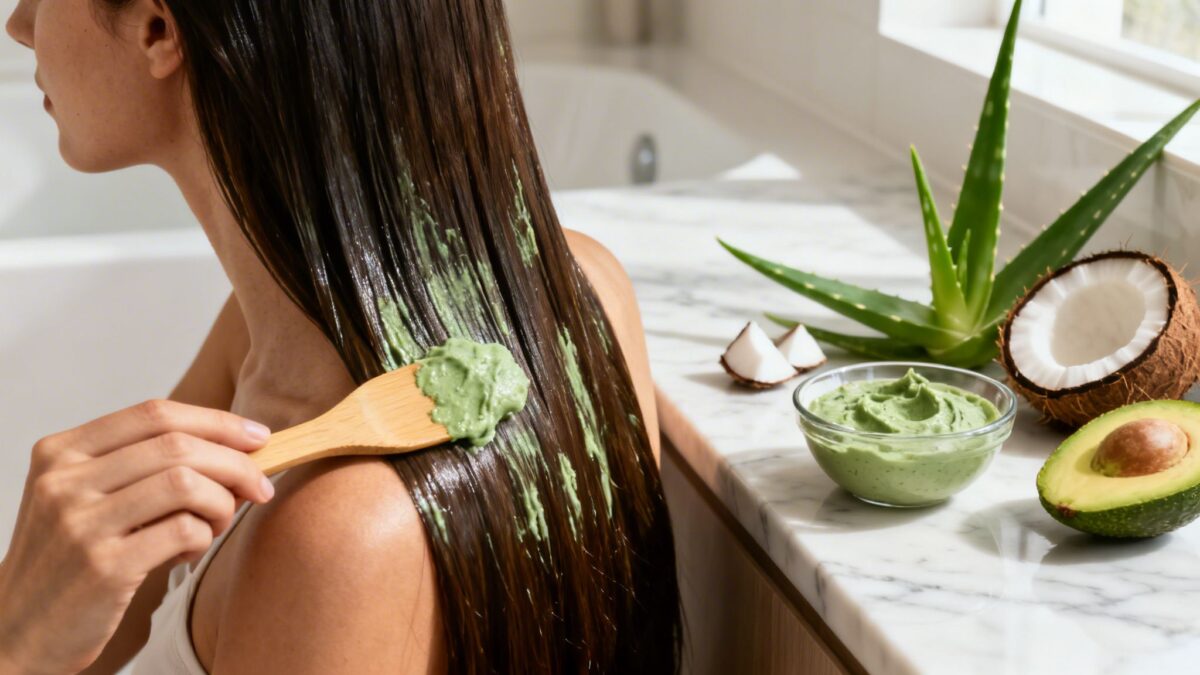

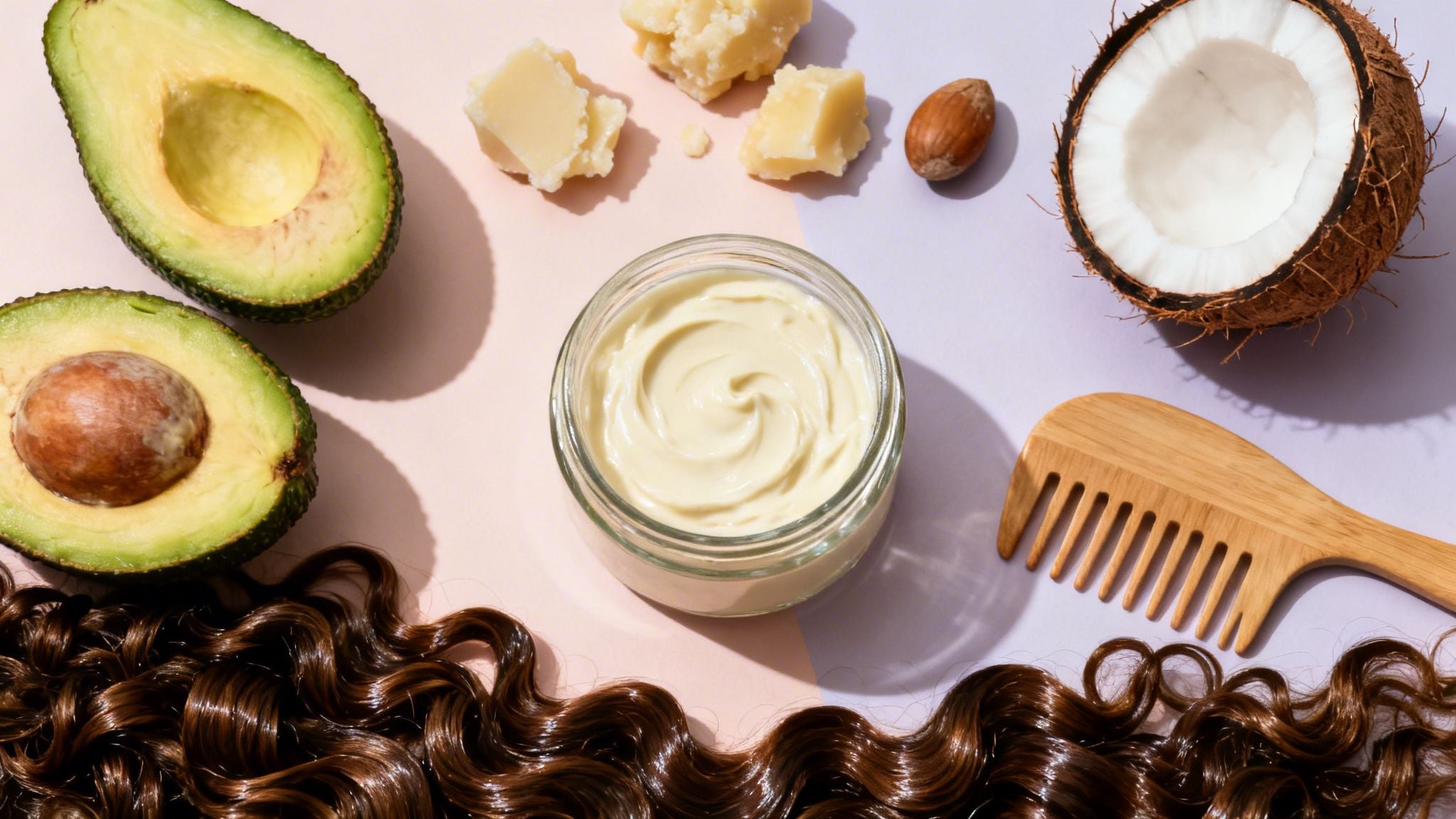
When we talk about the top deep conditioners for natural hair, we're really talking about the products that deliver on their promises. You know the ones—they melt away tangles, drench your curls in moisture, and leave your hair feeling like silk without weighing it down. Products like the TGIN Honey Miracle Hair Mask or SheaMoisture's Jamaican Black Castor Oil masque are famous for a reason; they have a track record of reviving even the most stressed-out strands.
Why Deep Conditioning Is Your Secret Weapon
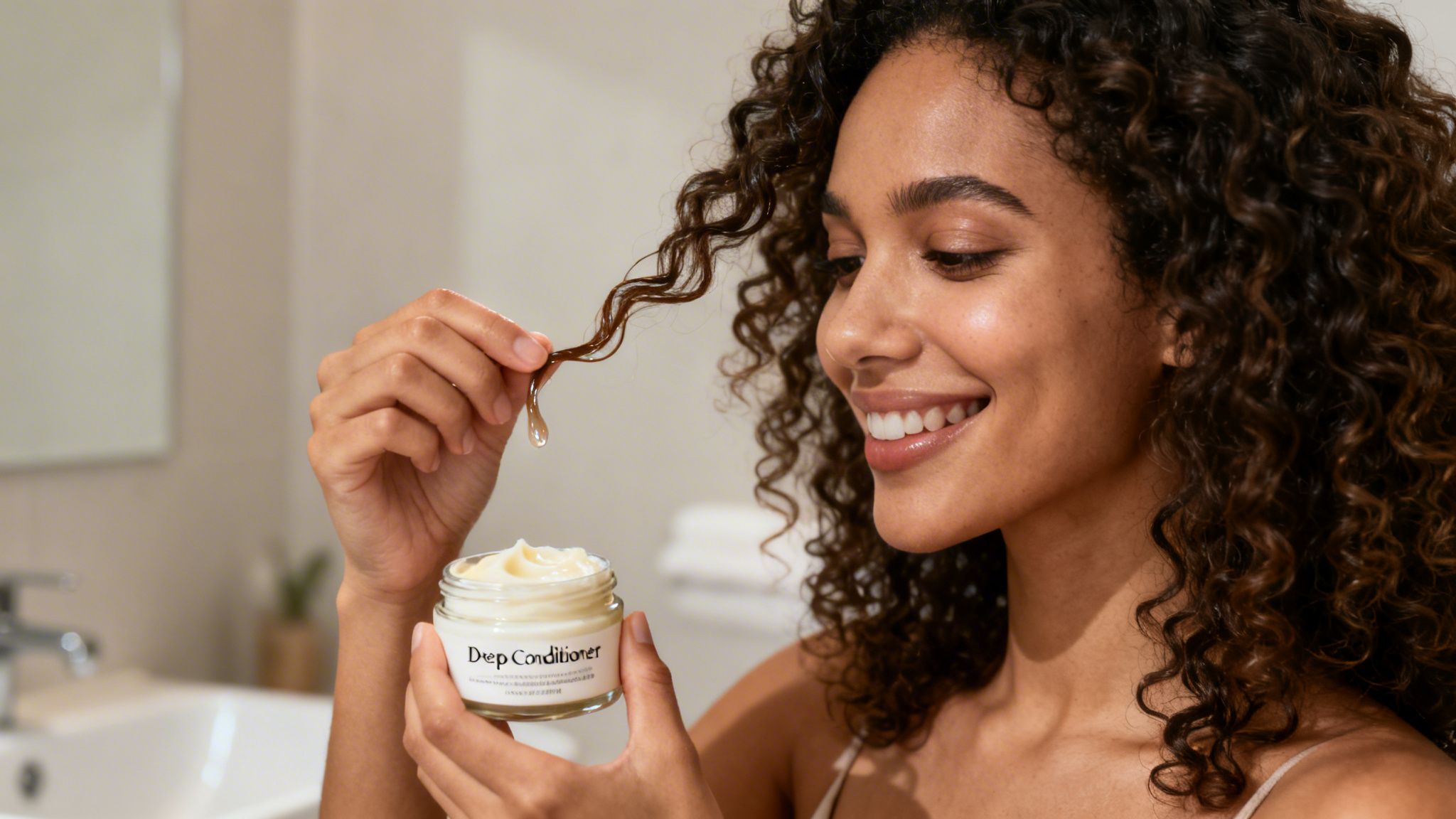
Let's get straight to the point: if you aren't deep conditioning, you're missing out on the single most powerful step for healthy natural hair. If you're tired of fighting with dryness, breakage, or frizz, this is where the battle is won. It’s the difference between a quick surface-level rinse and a true therapeutic treatment for your hair.
Think of it like this: your daily rinse-out conditioner is like a quick moisturizer for your skin, but a deep conditioner is a full-on hydrating facial. It’s made with richer, more concentrated ingredients that are meant to sink deep into the hair shaft, not just sit on top. This is where real restoration happens.
The Core Benefits for Natural Hair
Bringing a deep conditioner into your weekly routine isn't just about getting soft hair for a day or two. It's an investment in your hair's long-term health, strength, and resilience.
This quick table breaks down exactly how a deep conditioner can target your biggest hair frustrations.
At a Glance Deep Conditioner Benefits for Natural Hair
| Hair Concern | How Deep Conditioners Help | Key Ingredient Type to Look For |
|---|---|---|
| Dryness & Brittleness | Deeply infuses the hair shaft with lasting moisture to improve softness and flexibility. | Humectants (Glycerin, Honey), Butters (Shea, Mango) |
| Breakage & Weak Strands | Fills in gaps in the hair cuticle and reinforces its structure, reducing snaps and splits. | Proteins (Hydrolyzed Keratin, Silk), Amino Acids |
| Tangles & Knots | Coats strands to create "slip," making detangling much easier and less damaging. | Emollients (Oils like Coconut, Avocado), Behentrimonium |
| Dullness & Lack of Shine | Smoothes and seals the outer cuticle layer, allowing hair to reflect light better. | Oils (Argan, Jojoba), Fatty Alcohols (Cetyl Alcohol) |
These benefits aren't just marketing buzz; they are the foundation of a solid natural hair care regimen. By addressing these core issues, you set your hair up for success.
Here’s what that looks like in practice:
- Restores Moisture and Elasticity: Because of their beautiful twists and turns, curly and coily hair types often struggle to stay hydrated. Deep conditioners are packed with ingredients that replenish that lost moisture, giving your hair the bounce and flexibility it needs to resist breakage.
- Improves Manageability and Reduces Tangles: A good deep conditioner provides tons of slip, which dramatically cuts down on the time and tears spent on detangling. Your comb will glide through your hair, not fight against it.
- Enhances Shine and Vibrancy: Healthy, hydrated hair has a natural glow. By smoothing down the hair's cuticle, deep conditioners create a more uniform surface that reflects light, making your curls look vibrant and alive.
- Strengthens and Reduces Breakage: Many formulas include small proteins and amino acids that act like patches for weak spots along your hair. This fortification helps your hair stand up to daily styling and manipulation, which is key for retaining length. For a more holistic approach, you can also learn how to reduce hair breakage naturally.
A deep conditioner is your primary defense against the elements and styling stress. It acts as a reset button, ensuring your hair has the foundational strength and moisture it needs to thrive.
The proof is in the numbers. The global hair conditioner market is booming, expected to hit $9.62 billion by 2034, and a huge part of that growth is driven by products for natural hair. For those of us with curls, these targeted treatments can boost moisture retention by up to 40% more effectively than a standard conditioner. You can dive deeper into these hair conditioner market trends on fortunebusinessinsights.com.
My goal with this guide is to help you cut through the noise. We'll move past the confusing labels and trendy ingredients to find the perfect deep conditioner your hair has been waiting for. It all starts here, by understanding what these treatments can truly do for you.
Understanding How Deep Conditioners Revive Your Hair
So, what really happens when you slather on that deep conditioner and let it sit? It can feel like magic, but there's some simple science at play. Let's break it down without getting lost in technical jargon.
I love using the pinecone analogy. Picture a single strand of your hair as a tiny pinecone. When your hair is healthy and full of moisture, the "scales"—your hair cuticles—lie down flat and smooth. This flat surface reflects light beautifully, which is what gives your hair that healthy, brilliant shine.
But when hair gets dry, damaged, or sees too many chemical treatments, those cuticle scales lift and open up. This is a problem because it leaves the inner core of your hair (the cortex) exposed and vulnerable. A lifted cuticle is the culprit behind hair that feels rough, tangles in a second, and looks dull.
Your regular, rinse-out conditioner is great for a quick fix. It's designed to work on the surface, smoothing down those lifted cuticles to help with detangling and give you a temporary silky feel. Think of it as a surface-level solution, but it doesn't get to the root of the problem inside the hair strand.
The Power of Penetration
This is where a deep conditioner completely changes the game. Unlike its daily cousin, a deep conditioner is packed with more powerful ingredients and smaller molecules. They are built to do one thing exceptionally well: get past that lifted cuticle and travel deep into the hair’s cortex.
A deep conditioner isn’t just putting a shiny coat on your hair; it’s delivering a concentrated shot of nutrients straight to the core, where your hair’s strength and moisture are determined. It’s the difference between watering a plant's leaves and watering its roots.
Once those ingredients are inside the cortex, they get to work repairing and replenishing your hair from the inside out. This internal repair is what leads to real, lasting improvements in your hair's health, not just a cosmetic touch-up. And it’s why finding the right one is so crucial for keeping natural hair healthy and happy.
Moisturizing vs. Protein: What Your Hair Needs
Not all deep conditioners do the same job. They generally fall into two main categories, and knowing the difference is the key to giving your hair exactly what it's crying out for.
1. Moisturizing Deep Conditioners
- What they do: These are your ultimate thirst-quenchers. They’re loaded with humectants like glycerin and honey, which pull moisture into the hair, and emollients like shea butter and avocado oil, which seal it all in. Their main goal is hydration, hydration, hydration.
- When to use them: If your hair feels dry, brittle, rough, or just plain thirsty, reach for a moisturizing treatment. These are your best friend for restoring softness, elasticity, and juicy bounce to your curls.
2. Protein Deep Conditioners
- What they do: Think of these as the construction crew for your hair. They contain hydrolyzed proteins (like keratin or silk) and amino acids that are small enough to patch up the holes and weak spots along the hair shaft, reinforcing it from within.
- When to use them: If your hair feels limp, mushy when wet, overly stretchy, or is breaking a lot (especially after color or heat), a protein treatment will help rebuild its strength and structure.
Learning to "read" your hair's signals—dryness calling for moisture, weakness calling for protein—is a game-changer. It empowers you to stop guessing and start giving your hair the targeted support it needs for visible, long-lasting health.
How to Choose the Right Deep Conditioner for Your Hair
Walking into the hair care aisle feels like a pop quiz, doesn't it? Every bottle makes a new promise, and the sheer number of choices can be paralyzing. So, how do you find the one? The real secret isn't about chasing the buzziest brand—it's about learning the language of your own hair.
Forget the guesswork. Once you understand a few key things about your hair's personality, picking from the top deep conditioners for natural hair becomes second nature. It all boils down to three main factors: hair porosity, your curl pattern and thickness, and any specific goals you have, like fighting frizz or repairing damage.
Let's break it down.
Start With Your Hair's Porosity
Think of porosity as your hair's relationship with water. It dictates how easily moisture can get into your hair shaft and, more importantly, how long it decides to stick around. This single trait is why a deep conditioner that your friend raves about might leave your hair feeling greasy or, worse, still dry.
You'll generally fall into one of three porosity categories:
- Low Porosity: The cuticles on your hair strand are packed down tight, like a sealed gate. This makes it tough for moisture to get in, which is why your hair might take forever to get fully wet in the shower. The good news? Once moisture is in, it's locked in.
- Normal Porosity: Here, the cuticles are relaxed and flexible. They let moisture in easily and don't let it escape too quickly. This is the happy medium that's often the easiest to manage.
- High Porosity: Your hair's cuticles are wide open, either due to genetics or damage from heat and chemicals. This means your hair soaks up water (and product) like a sponge but loses it just as fast, leaving you prone to dryness, frizz, and breakage.
Not sure where you land? The "float test" is a classic starting point. Just drop a clean, product-free strand of hair into a glass of water. If it floats on top, you likely have low porosity. If it sinks nice and slow, you're probably in the normal range. And if it plummets to the bottom? You've got high porosity hair.
This little chart can also help you figure out where to focus your efforts first.
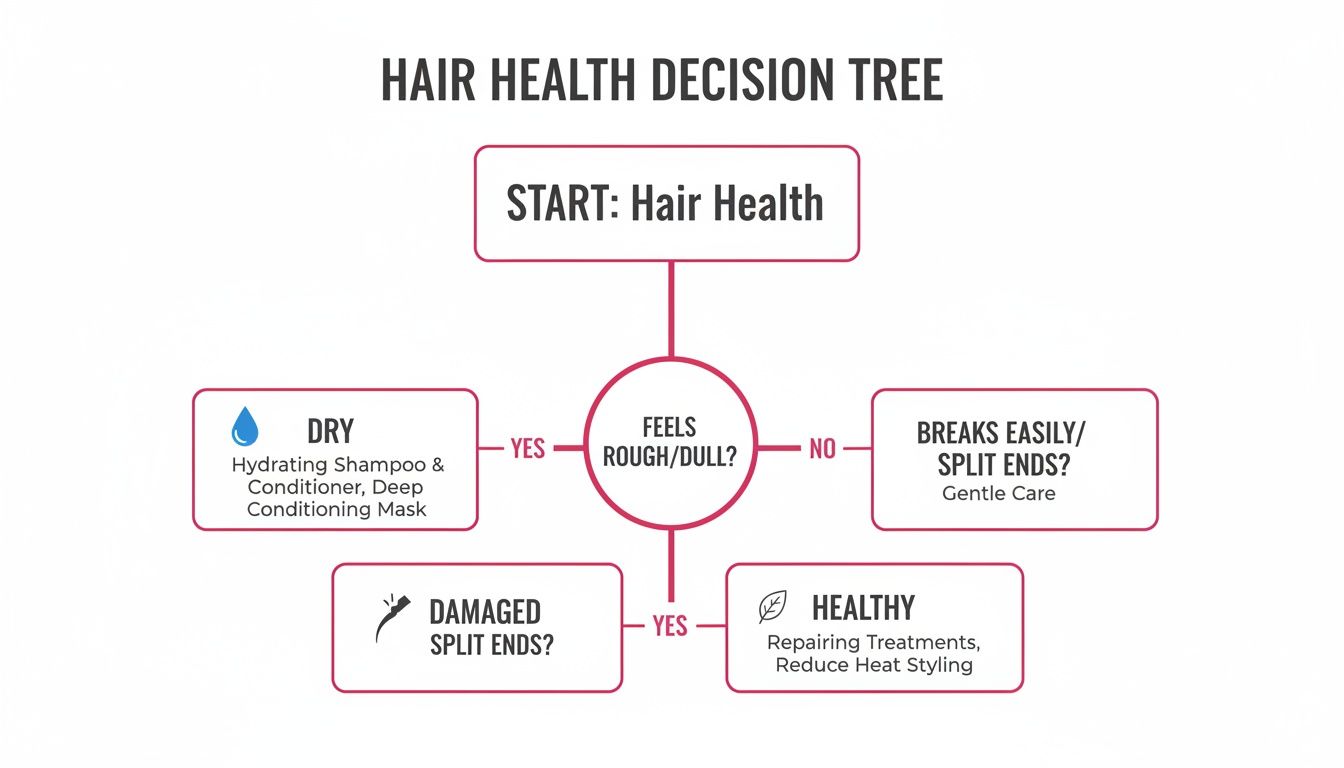
As you can see, simply knowing if your main battle is with dryness or with damage can set you on the right path to the perfect treatment.
Match Ingredients to Your Porosity and Hair Type
Okay, now that you have a good idea of your porosity, you can start playing detective with ingredient labels. This is where the magic really happens.
For Low Porosity Hair
You need to gently coax moisture past those sealed cuticles without just plastering product on the surface. That means lightweight ingredients are your best friend.
- Look For: Light oils like grapeseed, argan, and jojoba are perfect. Also, seek out humectants—ingredients that pull moisture from the air into your hair—like glycerin, honey, and aloe vera.
- Try to Avoid: Heavy butters (especially unrefined shea or cocoa butter) and super thick oils like castor oil. They'll just sit on your hair, leading to buildup and weighing your curls down.
For High Porosity Hair
Your job is the opposite. You need to fill in those gaps in the hair cuticle and create a seal to stop all that precious moisture from escaping. Go for the rich stuff.
- Look For: Nourishing butters like shea and mango, along with sealing oils such as olive, avocado, and castor oil. Your hair will also thank you for proteins like hydrolyzed keratin or silk amino acids, which act like spackle to patch up weak spots.
- Try to Avoid: Don't be shy! Very light, water-based formulas might feel nice initially but won't provide the long-lasting seal you need to combat chronic dryness.
This kind of ingredient-focused shopping is exactly why the natural hair community is making waves. The global hair conditioner market is set to hit $25 billion by 2026, and a huge part of that growth comes from savvy customers like you demanding targeted solutions. We're seeing formulas that can increase hydration by 50% with natural powerhouses like aloe and avocado. It’s no wonder that 57% of Black hair care consumers now reach for organic deep treatments, driving a 20% yearly jump in online sales for these products. You can read more about these hair conditioner market insights on datainsightsmarket.com.
The Ingredient Cheat Sheet
To make it even simpler, here’s a quick-reference table. Use this when you’re standing in the aisle, trying to decode a product label.
A great deep conditioner is built on ingredients that deliver moisture, protein, or both. Here’s a look at some of the best (and a few to watch out for).
Deep Conditioner Ingredient Cheat Sheet
| Ingredient | What It Does (Benefit) | Best For Hair Type/Concern | Ingredient to Avoid |
|---|---|---|---|
| Shea Butter | Rich in fatty acids; deeply moisturizes and seals. | High Porosity, Dry/Damaged Hair | Overuse on Low Porosity or Fine Hair |
| Glycerin | A humectant; draws moisture from the air into the hair. | All Porosities, especially Dry Hair | High concentrations in very dry climates |
| Hydrolyzed Protein | Small protein molecules that patch and repair the hair cuticle. | High Porosity, Damaged, Color-Treated Hair | Protein-sensitive hair |
| Aloe Vera | Hydrates, soothes the scalp, and provides lightweight moisture. | Low Porosity, Fine Hair, Itchy Scalp | (Rarely problematic) |
| Argan Oil | A light oil that adds shine and moisture without buildup. | Low Porosity, Fine to Medium Hair | – |
| Coconut Oil | Penetrates the hair shaft to reduce protein loss. | High Porosity, Damaged Hair | Protein-sensitive or Low Porosity hair (can cause buildup) |
Remember, this is a guide, not a set of rigid rules. Your hair is unique, so feel free to experiment to find what it loves most.
Address Your Specific Hair Concerns
The final piece of the puzzle is you. What is your hair going through right now? Are you recovering from a bleach session, fighting with a flaky scalp, or just trying to give fine curls some love without weighing them down?
Your deep conditioner should be a multi-tasking hero. It should not only fit your porosity but also directly address your most pressing hair challenges.
Here’s how to fine-tune your choice based on common hair goals:
- For Dry, Thirsty Hair: Your mantra is moisture, moisture, moisture. Load up on humectants like honey and glycerin, and lock it all in with rich butters like shea and mango. For more ideas, check out our popular guide on how to add moisture to dry hair.
- For Damaged or Color-Treated Hair: Your hair is crying out for reinforcement. Look for formulas that explicitly mention repair and contain proteins like hydrolyzed keratin, wheat, or silk protein. These ingredients help rebuild your hair's strength from the inside out.
- For Fine Hair: The goal is hydration without the heavy feeling. Stick to lightweight formulas and avoid those super-thick butters. Light, absorbent oils like argan and grapeseed will be your best friends.
- For An Itchy or Flaky Scalp: Look for a product with benefits for both scalp and strands. Soothing ingredients like tea tree oil, peppermint oil, and chamomile extract can work wonders to calm irritation while the conditioner gets to work on your hair.
By layering these three pieces of knowledge—porosity, ingredients, and your personal hair concerns—you can walk down that hair care aisle with confidence. You're no longer just buying a product; you're choosing the perfect nutritional meal for your hair.
Your Ultimate Deep Conditioning Ritual for Maximum Results
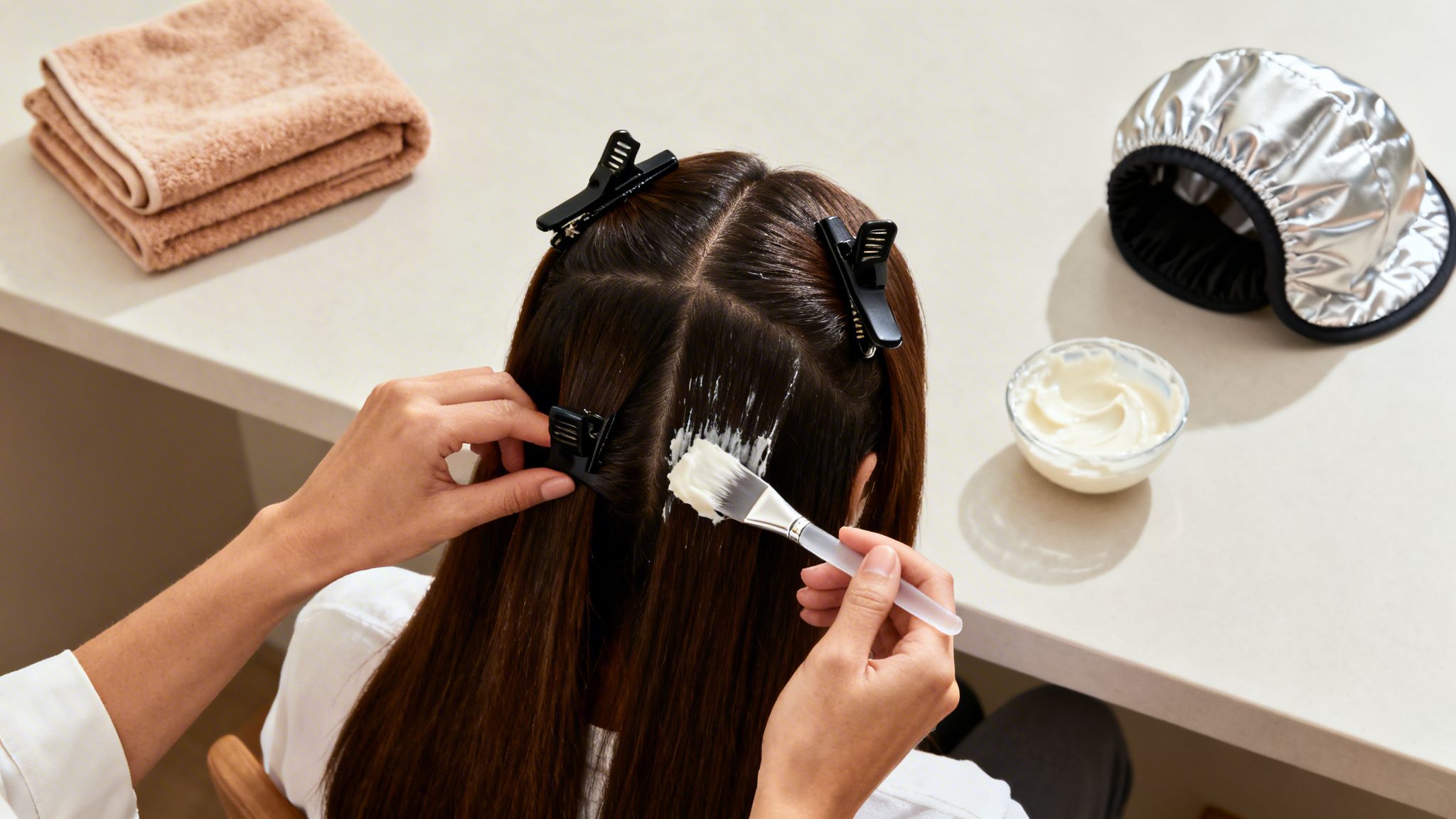
So, you’ve picked out one of the top deep conditioners for natural hair. Now what? The real magic isn’t just in the product—it's in the process. Turning your treatment into a thoughtful ritual, instead of just another rushed step in the shower, is what separates okay results from truly incredible hair.
Think of it like cooking a gourmet meal. You wouldn't just toss expensive ingredients into a pan and hope for the best. You prep, you season, and you cook with intention. Your hair deserves that same level of care.
Step 1: Prep Your Canvas
Before you even unscrew the lid, your hair needs to be ready. Deep conditioners work best on a clean, receptive canvas. Applying a rich treatment over hair that's already coated with old products, oils, and daily grime is like trying to paint a dirty wall. It just won't stick.
Start by washing your hair with a gentle, sulfate-free shampoo. This gets rid of any buildup that could block the treatment from penetrating. It also gently lifts the hair's outer layer, the cuticles, making them ready to soak up all the nutrients. After rinsing, gently squeeze out the excess water until your hair is damp but not dripping wet.
Step 2: Apply with Purpose
This is where a little technique goes a long way. Simply slathering conditioner on the top of your head and calling it a day is a missed opportunity. To make sure every single strand gets the attention it needs, you have to be methodical.
- Section your hair. Working in manageable sections is a game-changer. Divide your damp hair into four, six, or even eight parts. This keeps things organized and prevents your curls from tangling back up as you go.
- Start at the ends. Your ends are the oldest, most fragile part of your hair, so they need the most love. Apply a generous amount of deep conditioner there first, then work your way up the hair shaft toward the roots.
- Use the "praying hands" method. Take a section, smooth the product down its length with your palms pressed together, and glide from root to tip. This simple move ensures every strand is coated and helps smooth the cuticles down.
- Detangle gently. With all that amazing slip from the conditioner, now is the perfect time to work through any knots. Use your fingers or a wide-tooth comb and be patient.
This focused approach is more important than ever. The Black hair care market is projected to jump from $8.85 billion in 2026 to $14.34 billion by 2035, a trend driven by the 47% of consumers who now prefer DIY routines at home. With natural formulas containing ingredients like jojoba oil known to penetrate hair 30% deeper than standard ones, proper application is what unlocks that potential. You can dive deeper into these Black hair care market trends from Business Research Insights.
Step 3: Turn Up the Heat
Here’s a simple trick that makes a world of difference, especially if you have low-porosity hair that tends to resist moisture. Adding a bit of gentle heat opens up those stubborn hair cuticles, allowing the conditioner to penetrate much more deeply.
Think of heat as an express lane for nutrients. It opens the door so all the moisturizing and strengthening ingredients can get right to the hair’s core—the cortex—where the real repair work happens.
You don’t need a fancy salon steamer. Just pop on a simple plastic processing cap (or even a clean grocery bag) to trap your body heat. To give it an extra boost, wrap a warm, damp towel around your head or use a thermal heat cap for about 20-30 minutes. Using warm oils, similar to a hot olive oil treatment, can also help achieve this effect.
Step 4: Get the Timing and Rinsing Right
While it's tempting to think "longer is better," leaving a deep conditioner on for hours can actually backfire. This can lead to something called hygral fatigue, or moisture overload, which leaves your hair feeling weak, mushy, and limp.
Stick to the time recommended on the product label. For most treatments, that's somewhere between 20 and 30 minutes—the sweet spot for maximum absorption without overdoing it.
When it's time to rinse, use cool or lukewarm water. This helps seal the hair cuticles back down, locking in all the goodness you just added. Keep rinsing until your hair feels soft and clean, not slippery or coated. That’s how you know you've done it right. This simple ritual will turn your deep conditioning day into a reliable process for strong, healthy, and beautiful hair.
Decoding Product Labels With Real Examples
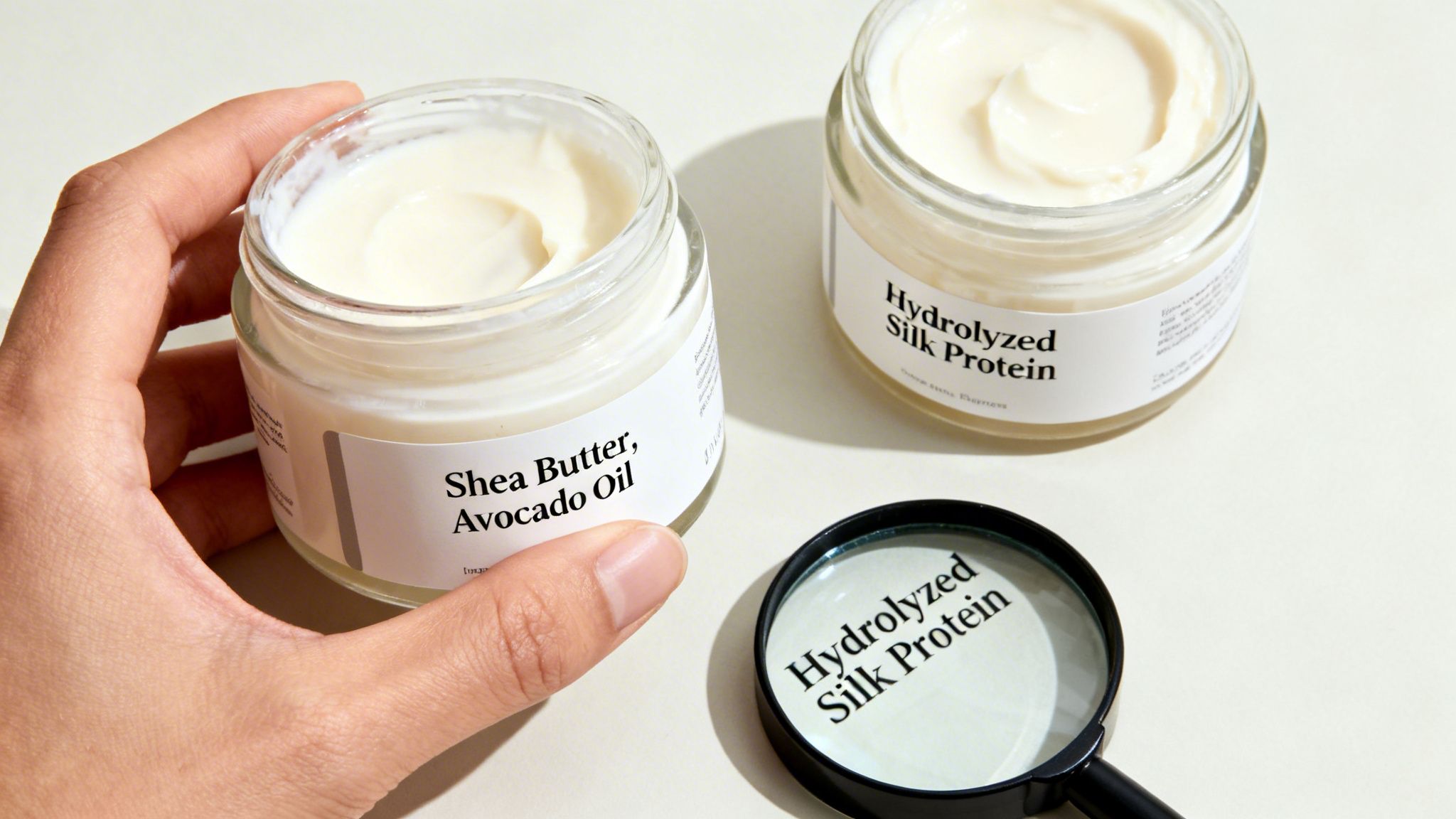
It’s one thing to understand the science, but it’s another to be standing in the hair care aisle, completely overwhelmed. Let’s put all that theory into action. This isn't about finding the one "best" product. Instead, this is about learning to spot the right product for your hair's unique needs, no matter what brand is on the label.
Think of yourself as a hair detective. The ingredient list is your primary clue sheet, and your mission is to find the formula that cracks your hair’s case. By walking through a couple of real-world scenarios, you'll see exactly how to connect your hair problems with the ingredients meant to solve them.
Example 1: The Intense Moisture Seeker
Let's imagine your hair feels like straw. It's brittle, constantly thirsty, and you're seeing more breakage than you'd like. Your mission is clear: you need a deep conditioner focused purely on hydration and moisture retention. On the shelf, you'll be drawn to labels promising "intense moisture," "hydration," or "quenching."
Now, turn that jar around. The ingredient list is where the truth lies. For deep, lasting moisture, you want to see these players high up on the list:
- Powerful Humectants: Look for glycerin, honey, or aloe vera juice. These are moisture magnets, literally pulling water from the air and drawing it into the hair shaft.
- Rich Emollients: Next, you need something to lock that moisture in. Scan for heavy-hitters like shea butter, mango butter, avocado oil, and olive oil. They create a protective seal around the hair strand.
A great example of this profile is the TGIN Honey Miracle Hair Mask, long beloved for its incredible slip and moisturizing power. Its top ingredients are raw honey and olive oil—a classic humectant-and-emollient combo that directly targets dryness. When you find a product with a similar ingredient profile, you can feel confident it's built for hydration.
Reading an ingredient list is like reading a recipe. The first few ingredients make up the main course; they tell you exactly what that product is designed to do.
Example 2: The Protein Repair Hero
Now for a different scenario. Maybe your hair feels mushy or gummy when wet, stretches like a rubber band before snapping, and generally lacks body. This is a classic sign of a compromised protein structure, often after a color treatment or heat damage. Your hair is crying out for strength. You need a protein-based treatment with keywords like "repair," "strengthen," or "restructuring."
The ingredient list for a repair-focused mask will look very different.
- Strengthening Proteins: The star of the show should be hydrolyzed proteins. Look for hydrolyzed keratin, hydrolyzed silk protein, or hydrolyzed wheat protein. That word, "hydrolyzed," is crucial. It means the protein molecules have been broken down small enough to penetrate the hair shaft and patch up the weak spots from the inside out.
- Amino Acids: As the literal building blocks of protein, ingredients like silk amino acids are also fantastic indicators of a true strengthening formula.
A product designed for repair will feature these ingredients right at the top. It provides the internal scaffolding your hair desperately needs to regain its structure and bounce.
By learning to spot these key ingredients, you can confidently choose the top deep conditioners for natural hair that will actually deliver the results you're looking for. You're no longer just a shopper; you're your hair's own expert.
Your Top Deep Conditioning Questions, Answered
Once you start deep conditioning regularly, you're bound to have some questions. It’s totally normal! Getting the little details right is what turns a good hair routine into a great one.
Let’s clear up some of the most common points of confusion so you can feel confident you’re giving your curls exactly what they crave.
How Often Should I Deep Condition My Natural Hair?
There's no single magic number here—it all comes down to listening to your hair. For most naturals, deep conditioning once a week is the perfect rhythm to maintain moisture, elasticity, and strength. Think of it as your regular weekly reset.
That said, your hair’s needs can change. If your hair feels extra thirsty, brittle, or you’ve just had it colored, bumping up your sessions to twice a week can make a huge difference. On the flip side, if your hair is healthy and low porosity, it might feel weighed down by a weekly treatment. In that case, stretching it to every two weeks could be your sweet spot.
Pay close attention to how your hair feels and behaves after a treatment. It will always tell you what it needs.
Can I Over-Condition My Hair?
Yes, you absolutely can! It’s a surprisingly common problem that happens when you give your hair too much of a good thing, throwing its natural balance out of whack.
Over-conditioning isn’t just about using a product too often; it’s about disrupting the delicate equilibrium between moisture and protein. Healthy hair needs both to be soft, but also strong.
Learning to spot an imbalance is key. Here’s what to look for:
- Hygral Fatigue (Moisture Overload): Your hair feels mushy, overly soft, or limp when wet. Your curls might look stretched out and struggle to hold their shape. The bounce is just… gone.
- Protein Overload: Your hair feels stiff, dry, and straw-like. It might seem unusually brittle and snap easily when you handle it. It's lost its natural softness and flexibility.
The best way to avoid this is to alternate between moisturizing and protein-based deep conditioners. One week your hair might be screaming for moisture, and the next it might need a little protein to reinforce its structure.
Is a Store-Bought or DIY Deep Conditioner Better?
This is a classic question, and honestly, one isn't better than the other. They just have different jobs, and both can have a place in your routine.
Store-Bought Formulas: These are developed by cosmetic chemists for a reason. They’re precisely formulated to be stable and effective, often containing ingredients like hydrolyzed proteins or specific cationic polymers that you just can’t replicate in your kitchen. They are designed to target and solve specific issues like significant damage or chronic dryness.
DIY Masks: Whipping up a mask with avocado, honey, yogurt, or olive oil is fantastic for general maintenance. It’s a simple, natural, and budget-friendly way to give your hair a quick boost of moisture and nutrients when it’s already in pretty good shape.
My advice? Rely on a well-formulated, store-bought treatment when you’re tackling a specific problem. For the weeks in between, a simple DIY mask can be an amazing and affordable way to keep your hair happy.
What Is the Difference Between a Deep Conditioner and Other Conditioners?
It's easy to see a shelf full of conditioners and feel confused, but each type plays a very specific role.
- Rinse-Out Conditioner: This is your post-shampoo detangler. Its main job is to quickly smooth the hair's outer cuticle, give you enough slip to detangle without breakage, and then be rinsed away. It works almost entirely on the surface.
- Leave-In Conditioner: This is the first step in your styling routine. It’s a lightweight cream or spray that provides a lasting layer of moisture, tames frizz, and helps protect your hair from the elements as you go about your day.
- Deep Conditioner: This is a heavy-duty treatment. Formulated with a much higher concentration of nourishing ingredients, it’s designed to penetrate deep into the hair shaft to repair, hydrate, and strengthen from within. It’s an intensive therapy session for your strands that must be rinsed out after it works its magic.
Think of it like this: your rinse-out is for daily detangling, your leave-in is for daily styling, and your deep conditioner is your weekly spa treatment.
At Hair and Body Review, we're dedicated to providing you with the knowledge to build a routine that works for you. With these answers, you're ready to find the top deep conditioners for natural hair and use them like an expert. For more honest reviews and tips you can trust, visit us at https://hairandbodyreview.com.